The Core of Civilization
OPINION | LOVE, ACTUALIZED
Ode to the Core
By Marcus Bui / Staff PhotographerBY HAMID DABASHI • DECEMBER 9, 2025 AT 10:55 AM
By Marcus Bui / Staff Photographer
BY HAMID DABASHI • DECEMBER 9, 2025 AT 10:55 AM
Soon after I earned my Ph.D. at the University of Pennsylvania in 1984 and concluded my postdoctoral fellowship at Harvard in 1986, I managed to land two adjunct visiting professorships, one at Columbia and the other at New York University. Within a year, both appointments had evolved into tenure track offers, of which I had to choose one.
One day our home phone rang and a voice from the other side said, “May I talk to Professor Dabashi?” I was not yet used to being called by that title. I said, “This is he.” The next sentence coming from the other side was opened with the most endearingly abrupt expletive you can imagine, asking what I was doing waiting to join Columbia. I said, “Excuse me, who is this?” The voice said, “This is Edward Said.”
After we hung up, I called George Saliba, chair of the Middle East languages and cultures department, as it was then called, and happily accepted the invitation to join Columbia’s faculty.
The late Michael Sovern, CC ’53, Law ’55, was our president at the time, and Jonathan Cole, CC ’64, GSAS ’69, one of the last visionary leaders of American higher education, was our provost. I served on the Columbia College Committee on Instruction under Jack Greenberg, CC ’45, Steven Marcus, CC ’48, GSAS ’61, and Austin Quigley, as our successive deans.
When I began teaching, I knocked at the office of Kathryn Yatrakis, GSAS ’81, then-dean of academic affairs, and said I wished to teach in the Core Curriculum. From my departmental base to the interdisciplinary and comparative proclivities in my teaching and scholarship, my entire Columbia experience centers around my commitment to the ethos of the Core, the very institutional signature of our university.
Love actualized: indeed!
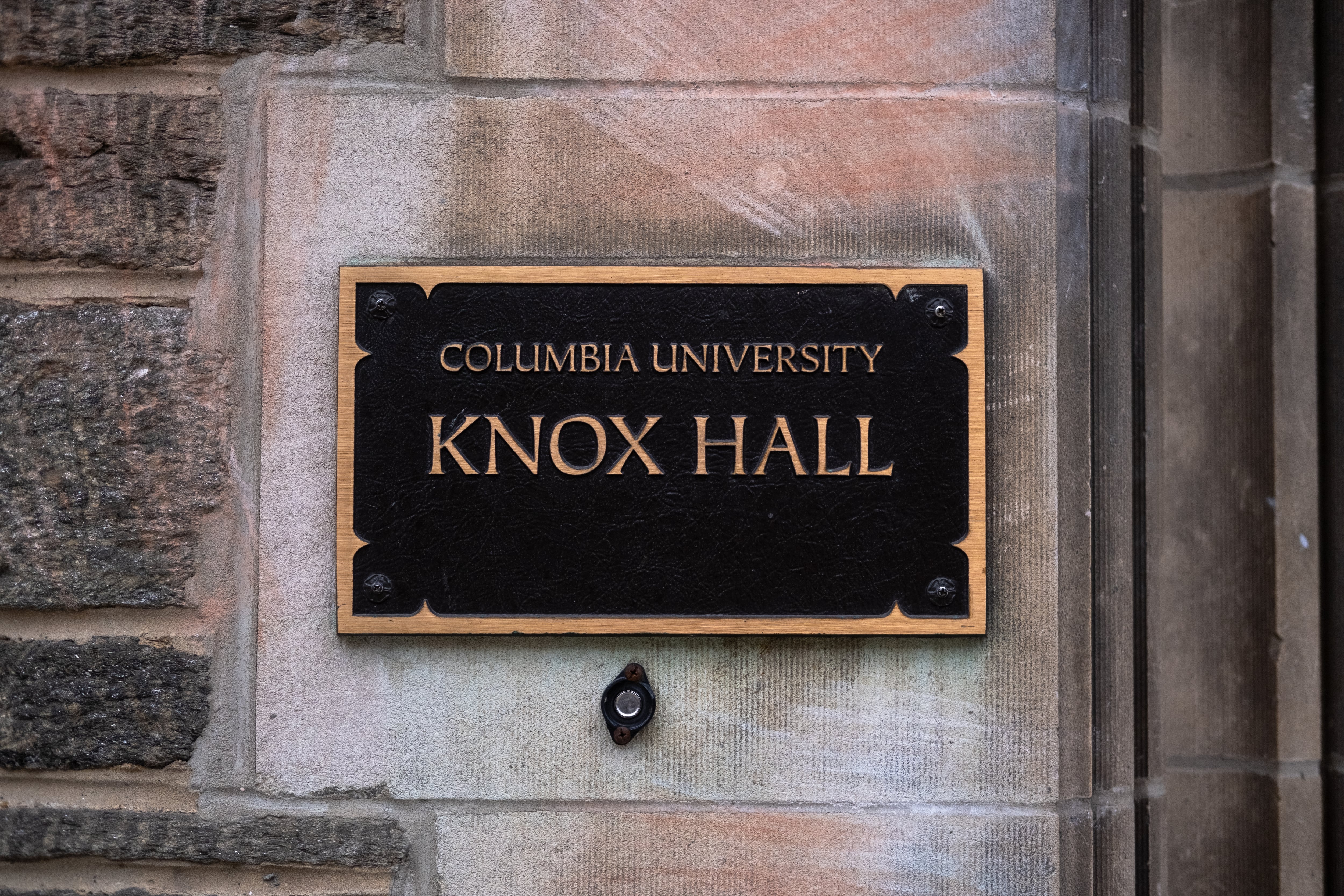
What is it exactly that I love about our institution? The gates, College Walk, the Sundial, Alma Mater, Low Steps, Kent Hall, where my sixth-floor office was for more than 20 years, before we were shipped to Knox Hall in fall 2009 against my loud and clear protests? Is it the constant confidence gained from seeing senior friends and colleagues of my own generation? Is it the changing colors and shapes, the culture that evolves with each successive class of students?
It is the whole of it and it is none of it in particular. It is the soul of the campus, its joys and tribulations, hopes and fears, troubled days and defiant determination to stay the course of its magnificent history against all odds. The chronicle of that history is written in our Core Curriculum.
The epicenter of our scholarly, pedagogical, and academic ecosystem at Columbia is not located in any individual department but rather in the very soul of the University to which we all belong and contribute. For me, the happy abode of that soul is our Core, representative of our collective commitment to cultivate in our students the critical judgment essential for responsible democratic citizenship.
Toward that goal, the significance of the participation of Middle Eastern, South Asian, and African studies faculty members and students in the Core cannot be overestimated. The Core has historically been staffed mostly by Eurocentric departments—English, French, Germanic, Italian, classics, history, philosophy, sociology, and political science. All of them are exceedingly caring and competent colleagues. It is however important to keep in mind that the inclusion of departments such as MESAAS and the department of East Asian languages and cultures can further widen the scholarly and pedagogical spectrum of the Core’s teaching faculty.
I am not in any way concerned with the actual content of Contemporary Civilization and Literature Humanities, or even Music Humanities and Art Humanities; those curricula are in the capable care of Core colleagues, go through regular revisions, and have now expanded well into the study of the larger Mediterranean basin and the Americas. Still, I am confident that expanding the teaching faculty outside European domains, to which our graduate student teaching staff remains vital, is central to the intellectual health of the Core.
In MESAAS, we teach the languages and cultures of vast swaths of humanity in Asia and Africa, with some of the most popular courses on campus coming from our department. Our presence in the Core brings that wealth of knowledge to bear on how we read and teach the Core. In my department, we teach languages and cultures ranging from Arabic, Armenian, Hebrew, Persian, Hendi-Urdu, Sanskrit, Tamil, and Turkish, to Swahili, Pulaar, and Wolof. The cultural mountain ranges of Arabic, Hebrew, Persian, and Sanskrit gather in one department to give us access to the original meanings of foundational Mediterranean masterpieces, just as Greek and Latin do for the humanities and social sciences at Columbia. Add to these terrains what Chinese, Japanese, and Korean do in our sister East Asian languages and cultures department, and you can fathom the value of including a diverse, global array of regional specializations. We read Aeschylus’ Oresteia in Lit Hum—the same Aeschylus who also wrote and staged The Persians.
I began my years at Columbia based in MESAAS but soon extended that base as a founding member of the Institute for Comparative Literature and Society, led by Andreas Huyssen and Gayatri Spivak. In the late 1990s, we redefined the very nature of compactivity on our campus. I take that background with me when I teach Contemporary Civilization and Lit Hum, as well as the Global Core courses I teach on Game of Thrones and Critical Theory: A Global Perspective.
Rooted as I am in that sustained history, it deeply troubles me that the steady course and the robust health of my department and my university, especially what we do at the Core, are a “terra incognita” to the outside world.
When our undergraduate students went on a hunger strike in 1996 demanding a department of ethnic studies, I was among the members of a blue ribbon committee appointed by then-University President George Rupp to address the crisis. Ira Katznelson, CC ’66, chaired that committee; the current Center for the Study of Ethnicity and Race is the result.
Our campus has seen many trials and tribulations. In the course of my own time at Columbia, I have witnessed the faculty protests in the early 1990s to maintain need-blind admission to the college, the trauma of the Sept. 11 attack on our city, and the “Gaza Solidarity Encampments” of 2024. These events have left us vulnerable to outside forces targeting the institutional health and academic integrity of our precious university. Through all this, the Core has remained like the mast of an indestructible ship, keeping our course steady.
Much horror is happening around the world, over which we have absolutely no control. Our task, our duty, our sacrosanct vocation inside these gates, is something entirely different. “In the Citadel,” as Archmaester Ebrose says to Samwell Tarly in Game of Thrones, “We lead different lives for different reasons. We are this world’s memory, Samwell Tarly.”
Teaching the Core is to keep the world’s memory alive. The Core teaches students to approach current global crises from a historical and global perspective, giving them the capacity to break free from reactivity and instead anticipate why something is happening and what might come next. We do our very best to help educate generations of students who come to us with their guards down and their hopes high. We should never import the world’s insanities into our campus. We must help cultivate a sustained sanity we can share with the outside world.
Comments
Post a Comment